
Picture a busy smart city where traffic lights shift on their own, waste bins ping when they are full, and air sensors warn everyone fast. A smart city is one that uses IoT systems in cities (sensors, cameras, and connected street gear) to spot problems early and respond with data, not guesses. Ever wonder how it all connects, from curbside parking to emergency alerts?
Here’s the key: smart city communication means those devices can share info, even when they run on different hardware, software, and networks. You’ll see the building blocks (IoT and networks), the rules that let devices talk (common protocols), and the setup that moves data where it needs to go (practical architectures). Then we’ll look at real city examples, what can go wrong (security, privacy, and budget limits), and what’s next as networks and edge computing get smarter.
So let’s start with the basics, then build up to how cities coordinate communication across thousands of moving parts.
The Core Building Blocks: IoT Devices and Key Networks
Smart city communication starts with physical devices. Then it builds outward, through networks that move sensor data to the right place, fast enough to act. In other words, you get better city decisions because the city can sense, send, and respond.
Why IoT Sensors Are the Eyes and Ears of Smart Cities
IoT in smart cities depends on one simple idea: tiny gadgets watch the city 24/7. They sit on poles, in sidewalks, on rooftops, and inside street gear. Most of the time, they do three things in a loop: measure, digitize, and transmit.
Traffic is an easy example. Sensors can detect vehicle flow, speed, and queue length at intersections. As a result, traffic systems can adjust signal timing sooner, instead of waiting for manual counts or slow reports. If you want a real-world feel for how traffic monitoring gets connected, see IoT traffic monitoring examples.
Parking also benefits from simple, repeatable sensing. Curbside or lot-based devices detect whether a spot is free. Then they report availability so drivers waste less time circling. Systems like those used by SFpark’s parking sensor approach show how real-time data can change behavior and reduce congestion.
Environmental sensors do similar work, just with different measurements. An air quality monitor measures pollutants like PM2.5 or NO2. A flood detector tracks rising water levels or rain intensity. When those values cross a threshold, the city can trigger alerts to maintenance teams or the public.
Here’s what makes these sensors work in the real world: they must run on low power and still send data reliably. Battery life matters, because most devices sit far from outlets. So designers use energy-saving modes, short radio bursts, and careful reporting schedules. In many setups, sensors connect to a nearby gateway using a low-power radio link, then the gateway carries data onward with higher-capacity service.
Edge computing often fits in here too. Instead of shipping every measurement to a distant cloud first, a nearby gateway or edge server can filter data, detect events, and package only what matters. That keeps reaction times tight, especially for safety events like flooding.

5G and LoRaWAN: The Networks Making It Possible
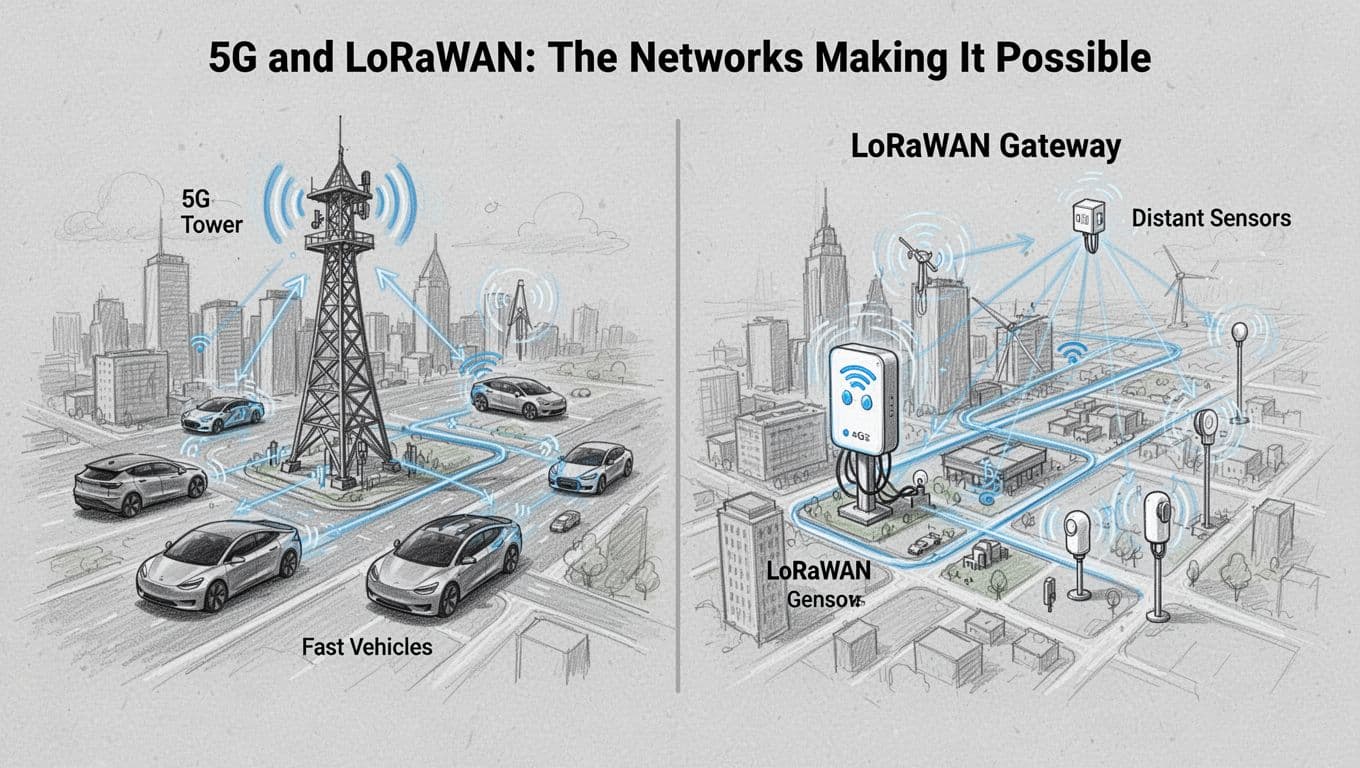
After sensors collect data, networks decide how that data travels. Two networks show up again and again for IoT in smart cities: 5G and LoRaWAN networks. They serve different jobs, like a superhighway and a bike path.
5G is your high-speed backbone. It supports low latency, so the city can react quickly when conditions change. It also handles big data loads, like video feeds from cameras or dense sensor bursts during peak events. With network slicing, cities can reserve performance for different services, such as traffic control versus public safety.
LoRaWAN, on the other hand, is built for long range and low power. It works well when devices run on batteries for years. It sends smaller packets at a slower pace, which is exactly what many sensors need. As long as the data arrives reliably, the speed is less important than the coverage and energy savings.
To make it feel simple, think of it like this: 5G is the superhighway, LoRaWAN the bike path for far-off spots.
A hybrid approach is common. In practice, LoRaWAN devices reach a local gateway, often mounted on a light pole or building. Then that gateway forwards collected data over 5G backhaul to the city platform. This setup reduces costs because you do not need 5G radios on every battery sensor. Instead, you concentrate expensive connectivity where it matters most.
The perks show up fast in day-to-day operations:
- Better traffic flow: LoRaWAN can cover wide areas, while 5G supports rapid updates to traffic systems.
- Energy savings: sensors use low power for long periods, so you reduce maintenance trips.
- Scalable coverage: one gateway can reach many sensors across neighborhoods.
If you want more guidance on matching range to smart city needs, where range matters for LoRaWAN is a helpful read. And for strategies cities use to scale LoRaWAN deployments, advanced LoRaWAN strategies for smart cities breaks down common planning choices.
Meanwhile, real-world momentum continues. Recent industry updates point to steady growth in LoRaWAN adoption for street lighting, parking, traffic monitoring, and air sensing, while 5G expands as a fast link for higher-demand services and backhaul. In short, cities often mix both to balance coverage, cost, and responsiveness.
Protocols That Let Systems Speak the Same Language
Smart cities run on one big promise: your sensors, apps, and control systems must understand each other. Since devices differ in power, bandwidth, and timing needs, they rarely share the same style of communication. Instead, they use protocols that match the job.
Think of protocols as language rules. Some are like quick texts (small messages, low overhead). Others act like calls with confirmations (requests, replies, and error handling). And for heavy data, you sometimes need “talk like a website” rules that move lots of bytes fast.
The best part is how these rules keep the city dependable. When the traffic system needs a reading now, it must get one. When a sensor reports later, it must arrive safely. When video shows up, it must not bog down everything else.
So, let’s look at three common protocol families that help smart city systems speak the same language, even when they live on different networks and hardware.
MQTT: Lightweight Messaging for Busy Sensors
MQTT in smart cities earns its keep by being simple and light. It uses a publish-subscribe model, so you do not have to set up one connection per device per recipient. Instead, devices publish messages to topics, and other systems subscribe to the topics they care about.
Here’s the core cast:
- Publishers: sensors or services sending data (like temperature or noise).
- Subscribers: city systems that want that data (like traffic control dashboards).
- Broker: the middle “traffic cop” that routes messages by topic.
In other words, MQTT is like texting a group chat broker. A sensor “posts” to a topic. The broker delivers it only to the subscribers who asked for that topic.
MQTT also defines QoS (Quality of Service) levels, which control how the system handles delivery. That matters a lot when radios fade or gateways restart.
- QoS 0 (fire-and-forget): no delivery check. Fastest, but you might lose messages.
- QoS 1 (at least once): the sender repeats until it gets an acknowledgment. You may see duplicates.
- QoS 2 (exactly once): the broker and client follow a tighter handshake. It reduces duplicates, but adds overhead.
Most city sensor data uses QoS 0 or QoS 1, because bandwidth and battery matter. For alarms, maintenance events, or safety signals, QoS 1 (or sometimes QoS 2) gives you peace of mind.

MQTT also fits smart cities because it stays efficient under stress. It keeps messages small, routes by topics, and avoids heavy request-response chatter. If you want a concrete example of MQTT handling real-time sensor monitoring, see how MQTT supports air-quality monitoring cases. For more on MQTT as infrastructure for city-scale data, HiveMQ’s smart city materials are also useful at a high level, like MQTT-powered smart cities.
CoAP and HTTP/2: Handling Requests and Speed
MQTT works well when you think in “events” and “topics.” But sometimes a city needs a clear request, a clear response, and tight handling for small devices. That’s where CoAP and HTTP/2 show up.
CoAP: Built for tiny devices that conserve power
CoAP (Constrained Application Protocol) is often described as mini-HTTP for constrained IoT. It uses UDP instead of TCP, which reduces overhead and helps small devices send quickly. It supports:
- request/response interactions (ask for a value, get a reply),
- confirmable messages (so the device can retry if it does not get an answer),
- multicast patterns (helpful for sending one instruction to many endpoints).
In a smart city, CoAP fits devices that cannot afford long sessions or heavy handshakes. Picture a street sensor that wakes briefly, checks a setting, sends a reading, then goes back to sleep. CoAP’s lightweight message style matches that rhythm.
Security also matters. CoAP commonly uses DTLS, which brings encryption and authentication suited for constrained environments. That keeps commands and readings protected, even when radios are busy.
To see how CoAP positions itself in IoT, this overview on CoAP protocol placement in IoT gives a straightforward starting point.
HTTP/2: Faster when bandwidth and multiplexing matter
HTTP/2 aims at speed and efficiency for web-style traffic. It keeps the benefits of HTTP, while improving performance through multiplexing (multiple streams over one connection). That matters when you mix a lot of calls at once, such as:
- dashboards pulling data,
- APIs feeding devices,
- services requesting status updates,
- camera integrations that need higher throughput.
However, HTTP/2 assumes networks can handle the connection management overhead. If you push too many constrained sensors through HTTP/2, you can overload links and raise failure risk.
Pros and cons in plain terms
Here’s a quick way to choose between them in smart city setups:
| Protocol | Best fit | Strength | Trade-off |
|---|---|---|---|
| CoAP | Tiny sensors and actuators | Low overhead, confirmable messages, multicast | Less friendly for large web-style payloads |
| HTTP/2 | Web and bandwidth-heavy services | Multiplexing for many parallel streams | Heavier connection behavior for constrained devices |

So the pattern you’ll often see is this: CoAP for small, request-based device control, and HTTP/2 for high-speed service traffic. Sometimes cities even mix both, with a platform layer translating between device-friendly messages and web-friendly API calls.
If you want a broader look at research comparing these families, an empirical evaluation of MQTT, CoAP, and HTTP for smart city IoT is a solid read for how they behave in real scenarios. For HTTP/2 on constrained devices, the HTTP/2 work for constrained IoT shows how implementers tackle the practical limits.
Architectures: How Data Travels from Sensor to Smart Decisions
Smart city architectures answer one question: how does raw sensor data turn into an action you can see? The answer is layered. Data starts at the edge, gets cleaned up near the street, then travels onward for wider storage and smarter decisions.
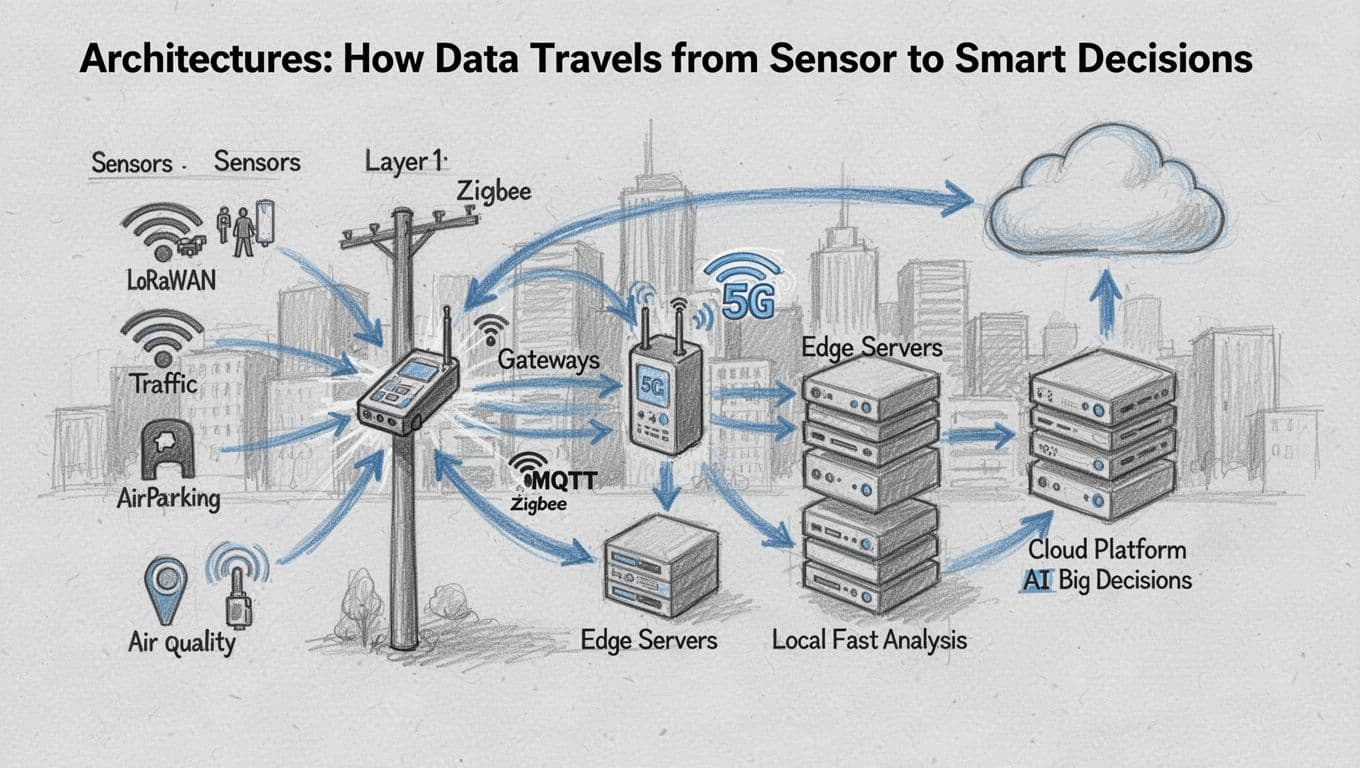
The layered data path in smart city architectures (sensor to decisions)
Think of the system like a delivery chain. A sensor measures a real-world condition, a gateway organizes it, and smart software decides what to do next.
Here’s the common layered flow used in smart city architectures:
- Devices send data (LoRaWAN, Zigbee, or other links) from the curb, pole, or meter.
- Gateways aggregate and forward using a bridge layer, often MQTT, to keep messaging efficient.
- Edge systems analyze locally so time-critical actions do not wait for the cloud.
- Cloud platforms store and run AI when patterns and long-term decisions matter.
This split is important. It keeps the city responsive when seconds count. At the same time, it still builds a bigger picture for planning, forecasting, and audits.
In addition, these layers match real constraints. Sensors often run on batteries. Networks vary in coverage. Networks and latency change by neighborhood and time of day. Layering helps you design for those realities instead of hoping for perfect conditions.
Hybrid setups that balance low delay and city-scale storage
Most cities use a hybrid design, because one layer cannot do everything well.
- Scalability: Gateways and brokers handle lots of messages without each device talking to the whole platform.
- Low delay: Edge analysis can trigger fast responses, like rerouting or alerting.
- Cost control: You do not push every byte to the cloud. You send what matters after filtering.
Meanwhile, cloud services handle the slow work. They keep historical datasets, support dashboards, and run AI models that need context. If you want a helpful overview of how sensor data moves into AI-ready intelligence, see From Sensors to Data Intelligence with IoT, Cloud, and Edge Computing.
The rule of thumb is simple: edge fixes what you can act on now, cloud learns what you need later.
Example: LoRaWAN sensor to instant traffic-light adjustment
Picture a sensor near an intersection that detects a sudden queue forming.
First, the sensor sends readings over LoRaWAN to a nearby gateway. Next, the gateway aggregates reports and forwards them via MQTT toward the edge. Then, the edge system compares live conditions against traffic rules. It can decide immediately to shift signal timing. Finally, the cloud logs the event for later analysis and model updates.
That’s the architecture in motion: measure locally, decide fast, learn globally.
Real Cities Showing It Works: Singapore, Barcelona, and More
Real cities do not run smart tech because it sounds good. They run it because it reduces delays, cuts costs, and helps staff act faster. That means the best smart city examples 2026 share one thing: data flows from field sensors to systems that make decisions, then back out as real-world control.
In other words, it’s not magic. It’s an operating loop: sense, send, decide, and respond.

Singapore’s Traffic and Parking Mastery
Singapore pairs strong communications choices with practical control, especially for roads and curbside parking. For traffic, the city pulls signals from roadside sensors and connected inputs, then uses that stream to spot congestion early and adjust how drivers move. As a result, operators can reroute flow sooner, instead of reacting after a jam forms.
Parking gets treated the same way. The Parking Guidance System (PGS) helps drivers find open spots by using live availability signals, not guesswork. Then, the system shows that information in high-traffic areas like Orchard and Marina Centre, which reduces circling. In 2025, Singapore also spent $25 million on smart parking using IoT and related tech, showing how seriously it funds day-to-day convenience.
Under the hood, this setup fits the common smart-city pattern:
- LoRaWAN-style low-power sensing for data that does not need constant high bandwidth
- 5G for faster city services and backhaul, where responsiveness matters
- MQTT-style messaging to move small device updates toward the edge and control layers
If you want a concrete view of how Singapore builds low-power city sensing, check out SPTel’s LoRaWAN sensor network in Singapore. For traffic system context, how Singapore’s smart traffic works also maps the “sensor to control” idea clearly.
The win is simple: fewer delays and fewer wasted vehicle moves. When the city knows what’s happening now, it can act like a good dispatcher, not a tired referee.
Barcelona and Toronto’s Smart Innovations
Barcelona and Toronto show two different smart-city lanes, but the communication logic stays similar. Barcelona focuses hard on waste, while Toronto pushes for energy and traffic reliability, including flood readiness.
Barcelona’s waste improvements track a clear operational goal: stop trucks from running empty routes and reduce overflow. Sensors report bin status in real time, so crews plan pickups when containers actually need service. Reported outcomes include boosting recycling by about 30% and cutting waste by about 20%, which points to better sorting behavior and fewer missed collection moments. Even if the tech stack details vary by vendor, the pattern is consistent: field devices send small updates, systems turn that into route decisions, and operations get smarter each week.
For Barcelona’s broader smart-city framing, Barcelona Smart City programs gives a helpful look at how mobility, waste, and energy programs connect under one umbrella.
Toronto’s story is more about resilience and speed. By 2026, the city’s approach uses edge computing with 5G, plus MQTT-style messaging and LoRaWAN-style wide-area sensing for events that can’t wait. Flood monitoring fits naturally here. Sensors detect water conditions, the edge layer filters and reacts quickly, and 5G carries the urgent updates where control teams need them.
One reason this matters is network safety. If one area floods, the city still needs stable comms for other services. Research trends around balancing sustainability and security with 5G and IoT in smart cities highlight why cities treat reliability and protection as part of communication design, not an afterthought.
So what do both cities prove? Smart city communication works when it’s built as a practical pipeline. It turns sensor readings into faster pickups, less congestion, and better response during stress, which is exactly what residents feel day to day.
Challenges Standing in the Way and Exciting Trends Ahead
Smart city communication sounds tidy on paper. In real deployments, though, you hit hard walls fast. Battery life drops sooner than planned, networks get noisy, and security gaps show up like loose doors on a windy night. Still, the future of smart cities looks promising, because teams keep fixing the weak spots and building better patterns around them.

Battery drain and range-speed trade-offs you can feel in the field
Battery drain is the most visible pain point. Many city sensors live where maintenance crews cannot reach daily. Then they need reliable radio links while waking, sensing, and transmitting.
At the same time, you face the range-speed trade-off. LoRaWAN-style links often win on range and low power, but they move data slower. Meanwhile, 5G can push more data quickly, yet battery-powered endpoints may not be as simple.
So teams juggle three levers:
- How often devices report (more frequent messages drain power)
- How much data they send (small events beat heavy payloads)
- Where processing happens (edge compute can reduce what must travel)
Edge processing helps a lot. Instead of uploading every raw reading, a device or gateway can send only “something changed” events. In practice, that cuts radio time, and radio time is usually the biggest power sink.
If you want a clear view of common IoT hurdles that show up during scaling, this overview on top IoT challenges in 2026 matches what many city operators experience.
Security and privacy gaps in a city-wide attack surface
Security risks grow as the number of connected devices grows. A city links traffic systems, utility data, parking access, and public alerts. That creates a big attack surface, and attackers love big targets.
Weak spots often look boring at first. Old firmware, default passwords, missing patch plans, and loose device identity checks can all open doors. In addition, data privacy matters because many city sensors can indirectly identify people’s movement patterns.
To reduce risk, cities need protection that starts at the device, not after the fact. For example:
- Encryption in transit for sensor readings and control messages
- Strong device identity so only trusted gear can talk
- Access control so staff and vendors see only what they should
- Patch and update plans that match real device lifecycles
If you want a practical reminder on why IoT security stays hard, IoT security as a challenge for 2026 highlights how scale and trust collide.
Security is not a one-time install. It’s an ongoing lock-check on every node.
Scalability, interference, and cost pressure that stress the “pipe”
Smart city challenges do not stop at connectivity. They show up when you ask the network to carry a lot of traffic at once. Busy intersections, dense neighborhoods, and event days can cause congestion and packet loss.
Interference adds another layer. Radio signals do not respect property lines. Buildings, tunnels, and weather can weaken signals. Then the city gets more retries, which can increase both latency and power use.
Costs also pressure design choices. Rolling out thousands of sensors means budgets for hardware, installation, ongoing maintenance, and cloud or edge services. Replacing legacy systems can be expensive, especially when permits and construction schedules slow work.
The scalable path usually looks like a layered approach:
- Aggregation at gateways to reduce backhaul load
- Message routing with lightweight protocols to avoid chatty traffic
- Scheduling and buffering so devices transmit when the network is ready
If you want a broader look at how massive IoT systems strain energy, security, and scalability, energy and scalability in massive IoT helps frame the trade-offs.
Protocol mismatches and interoperability headaches across vendors
Even when connectivity exists, communication can fail due to protocol mismatches. Two vendors may both “support IoT,” but their device profiles, topic structures, message formats, or authentication methods may not match.
This problem shows up in the real world as integration work:
- Custom gateways that translate formats
- Separate dashboards per system
- Manual mappings that break during upgrades
You can think of protocols like different cooking styles. If you swap ingredients without adjusting the recipe, the meal still tastes wrong. Interoperability means aligning not only the radio link, but also the data model, naming, and security rules.
The good news is that the industry keeps pushing toward common patterns and better middleware. Still, you should plan early for integration testing. Waiting until late stages often turns one small mismatch into a city-wide delay.
Exciting trends ahead: LoRaWAN + 5G/edge, 5G RedCap, and smarter integration
The future of smart cities relies on hybrid designs and better device classes. Many cities will keep the long-range, low-power strengths of LoRaWAN-style networks, while using 5G or private wireless where speed and reliability matter most.
Edge AI and edge computing also look set to grow. They reduce delays by acting near the data source. More importantly, they reduce the amount of data that must cross the network.
Another trend gaining attention is 5G RedCap. It targets IoT devices that need more reliability than basic LPWAN, but do not need full “high-end” 5G. That can shrink power needs and improve feasibility for more sensors and controllers in the field. For what RedCap means for deployments, 5G RedCap and what reduced capability means offers a clear explainer.
Meanwhile, network slicing and hybrid clouds help when you split workloads. You can keep safety or control paths on tighter links. Then you can store large history datasets in cloud systems for analytics and reporting. This split also helps you handle vendor differences, because you standardize at the middleware layer instead of everywhere in the city.
And there is a community angle here too. The most durable smart city projects often involve local operators, integrators, and device makers working from the same operational goals. When teams share the same “what good looks like,” they plan for battery swaps, security updates, and maintenance windows from day one.
The exciting part is this: challenges are known. Teams now have clearer tools to handle them, so progress keeps moving.
Conclusion
Smart city communication works because systems share a common workflow, not because every device speaks one perfect language. Sensors gather real signals, networks carry them reliably, and protocols like MQTT, CoAP, and HTTP/2 keep messages understandable across different vendors and service needs.
Then layered architectures turn that data into action. Gateways and edge systems handle urgent choices quickly, while cloud platforms store history and support longer-term decisions. That’s why cities can reduce delays, improve service coverage, and respond faster during stress events like floods or traffic spikes.
The strongest takeaway is this: smart cities succeed when communication is treated as an end-to-end pipeline, from the street corner to the decision center. So as your city adds sensors, upgrades networks, and tightens security, keep an eye on how the whole chain performs.
Watch your city evolve, and share what you notice first, traffic updates, waste pickups, or emergency alerts. What change would you most want to see next in smart city communication?